Showing posts with label paganism. Show all posts

Saturday, April 25, 2015

A Come to the Goddess Talk

The Pagan Experience - Wk 4- Apr. 29 – Any writing for the letters G or H - I am keeping this familiar format on week 4 for those who have joined me from the Pagan Blog Project.

US citizens are probably familiar with the expression "come to Jesus". For example, if you know a young person who is acting up, you might say "Come here, you and I need to have a come to Jesus". As Pagans, I think we need to have a come to the Goddess chat.

As many of you know, I am both the High Priestess of a shamanistic witchcraft tradition, as well as an interfaith priestess with an interfaith and secular spiritual community. This week, I'm mad as Hades. Not into rants? Don't want to hear a truth? Leave now.

I see the USA becoming a battleground for large corporations, many of whom who are using religion as a polarizing force in their ongoing mission to strip the world of resources and crush the masses beneath their gilded heels.

I see our government, which began in response to religious and political tyranny, teetering between positive cultural change and regressive faith-based policy. We were specifically chartered as a secular government, yet we are still seeing debates about religious laws.

As a nation, we are actively fighting Islamic extremists, and supporters of this war decry their sharia law. Yet they want to institute the same thing here. Legislators and judges are trying to pass laws that say they don't have to do their job if it contradicts their religious beliefs. Their job is to serve the public - ALL OF THE PUBLIC. Any legislation that interferes with this mission is directly and starkly unconstitutional.

Iowa recently did a brave thing in having in having a Wiccan priestess give the invocation to begin a day of legislative work. Rep. Liz Bennett invited the speaker, and she has this to say about religious freedom and our government:

"When we say we believe in religious freedom and we believe in religious liberty, that means that we don't endorse one religion over another as a government," Bennett said. "And in fact, when you look at other countries who do show preference or endorsement for one religion over another, you can see it's not a very good situation. That's something the founders of our nation knew."

The fact that this occurred is a beautiful step forward. It was received respectfully by some, but others chose to turn their back or absent themselves from the proceedings. Others even organized prayer protests at the Capitol building in response. As if the very hearing of words from another faith would somehow besmirch them. As if their religion, which happens to be the majority religion in this case, holds the only truth in the world, and only they have the right to speak in public. I have so many problems with this, but that is truly another post unto itself.

In the midst of all this, we Pagans continue to bicker, exclude and bully. I chatted with a friend this week. It turned into a mutual venting session, which I think that we both really needed at the time. We both are community leaders, and we both are passionate about our need to unite as a community. She shared with me her frustrations about lack of support, gossiping, apathy, and exclusion. I was shocked and saddened. It seems to me that this conflict was about ego and pettiness. It seems that some people would rather be in the limelight and in control, rather than supporting my friend's sincere and altruistic goals for our community as a whole.

Look here, people: we cannot afford the infighting right now. There is no room for your ego here, in this tumultuous age of environmental crisis, political instability and war. We do not have the luxury of wasting our energy on gossip. Our apathy and cynicism is killing almost every attempt to unite and elevate us as a community.

I don't care what path you follow. I don't care what tradition to which you belong. I don't care how much training you have. I don't care how many degrees you have, what garter you wear. I don't care about your pins, your crowns, or your special robes. I don't care what you call yourself.

Ask yourself this one question: am I inside the Big Tent of Paganism? Before you say no, read the article. John Beckett has done a great job of describing what this blanket term means and how it is valuable to all of us: "Druids and Wiccans, Heathens and Hellenists, Thelemites and chaos magicians, shamans and seers, kitchen witches and tree huggers – there’s room for everyone."

So you're in the tent? Congratulations. That makes you part of a controversial minority faith, which honestly, is a dangerous place to be in some parts of the world, including mine. It should not be dangerous to you within the community. I myself have experienced the exclusion, the lack of welcome, the cliques, the judgments, the back-door deals. I've heard stories from so many Pagans over the years, both from newbies and experienced practitioners alike.

Why do we decry the poor behavior of other faiths, yet treat our own community with scorn and derision? Why do we hate being judged, but we ourselves judge our brothers and sisters? Why do we whine about the lack of gathering spaces, but refuse to support those trying to create them? Why do we kvetch about the difficulty of finding groups and resources, but hamstring the attempts of those who wish to unite us?

It has to stop. Right here, right now, with each of us. I wrote a blog post last year about suggestions for good Pagan citizenship. Check it out. Have suggestions of your own? Comment on this post. I truly welcome your feedback and input.

To summarize: be good to each other. Stop the drama, the gossip and the infighting. Show up, speak up and DO SOMETHING NOW. Join your local Pagan Alliance. Go to a local festival or retreat. Fight the apathy and let's make some magic happen!

Remember, we are all in this together, and we are stronger together. I believe in this community. I know we can do this!

With perfect love and perfect trust,
Tanaria

Tuesday, January 20, 2015

A Rocky Road to Illumination

Wk 3- Jan. 19- Deity and the DivineThis will be the third week’s topic every month and an opportunity for you to share with everyone those who guide, inspire and inform you.


My relationship with the Divine has been rocky. When I was young, I remember feeling so painfully alone that I was sure there was nothing out there. The concept of God taught to me as a child in a Catholic family made absolutely no sense to me. It made me angry, to be blunt. The whole "you're a sinner from birth" thing - not a hit with me. Nor was the whole "you're less than a man because you're a woman" thing. And He's watching me from the sky, judging and directing my every move? No thanks. Plus, the history of the church disturbed me - conversion by the sword, corruption, torture, burning witches, hoarding wealth, controlling people with fear…not for me, on so many levels.

I began to search for a different way, for different gods. The Greek pantheon was first, by way of grade school mythology. They were, at once, deeply familiar to me. I didn't like all of them, and at the time, I certainly had no conscious thought of a relationship with any of them. 

Soon after, I learned about Buddha. Here was someone I could relate to and respect. Here was a yogi - a meditation teacher! He wasn't really a god, according to him. But he knew a lot, wasn't into judging, and wanted to reduce suffering in the world. The philosophy of Buddhism did much to shape my thinking, but the religion and dogma of it left me cold, once again. 

Yoga has been a recurring theme and practice in my life. Now, most Yoga classes here in the US do not mention religion at all. Most yoga teachers are afraid to discuss the spiritual aspects of Yoga, especially in my region of the country. Occasionally, you will find a chant mentioning a god's name, like Ganesh or Brahma. This is generally not explained in detail. On my own, I learned about some of the many deities from Hinduism. I rather like Ganesh. He's a jolly sort! I'm also fond of Saraswati, Krishna (a flute player, go figure) and Kali. They aren't my peeps, nor is Hinduism for me. But I like it. Their ceremonies are lavish, beautiful, chaotic and peaceful - like life.

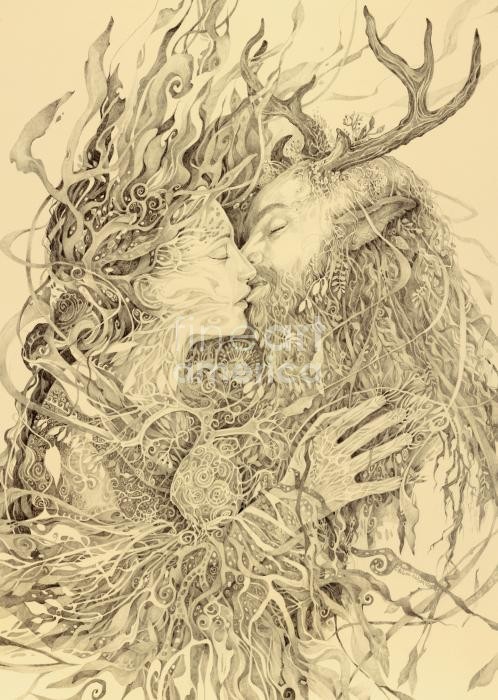
Eventually I found my way to Paganism. Reading about the Goddess as earth mother…it finally made sense. A deity OF this earth, who encourages stewardship of the Earth, who truly loves and provides for all…this I could deal with. And her consort, the Horned Lord…now I knew what face I sometimes saw in the woods. I recognized that primal urge to create and to live. The balance between Goddess and God felt right to me. I felt at home, and gained insight into many experiences of my life.

But still, I wasn't set afire by the Divine. I still felt alone. I still felt rebellious. No force on this Earth, no person, no god, no one, gets to tell me who to be or what to do! Authoritarian structures, no matter what flavor, just don't work for me. Lucky thing that as a pagan, I don't have to do anything. 

These days, I have a healthy relationship with the Divine as the universal force of attraction and creation, which manifests in the archetypal forms of gods and goddesses for us human beings to relate to, yet which is not confined by those forms. The Divine is mysterious and unknowable, and is also us. It is the life force and energy that constitutes all particles of matter in our Universe. The very Earth we walk upon is not just sacred because it is our home, but because it is alive with divine energy. 

Each step I take is a prayer. I relate to the gods of my personal pantheon with respect, but not a mindless obeisance. They have won me over at last with love, an easy affection, help and support. They inspire me and guide me without smothering me. They accept me with all of my contradictions. They are allies more than they are authorities.

A keystone of my mindset and outlook, though, is science. I don't believe anything 110%, nor do I follow anything or anyone with blind fervor. I am always open to learning, growing and evolving myself and my beliefs in the face of new evidence, new experiences and new insights. I like the archetypes and faith that I've chosen. It works for me, and makes me feel happy and fulfilled. But is it the absolute truth of reality? Yes and no. Is it the only truth in the world? No. Am I right and others are wrong? Absolutely not. 

Instead, I see the universe more like quantum physics is discovering it to be, which many ancient cultures knew long ago. This universe is a hologram. Physical, consensual reality is real, but it's also a show of smoke and mirrors. It is Maya, the world of illusion, as they say in India. I don't, however, see this as something to be looked down upon or transcended. We are put here to have experiences and to learn. To use the power of our will to co-create reality. Each one of us has immense power. Each one of us is divine. Each one of us is a unique and individual being, but also a drop in the ocean of universal energy. We are one!

Namaste - the divine light within me recognizes and honors the divine light within you. Blessed be!

Monday, July 7, 2014

Ethical Symbolism

A lot of Pagans begin their journey as solitaries, with books. I was sort of in that category myself. Actually, I had a ritual partner who was at the same point in the journey, and we did support each other quite a bit. But having said that, I mostly studied books on my own at first.

In most Pagan 101 books, a brief section is devoted to symbolism. Allow me to generalize and give you a summary:

"Hey guys, symbols are great and powerful - you should use them! Here are a few lists of magical alphabets and other mysterious symbols from around the world. Naw, don't worry, you're a baby witch, WHAT COULD GO WRONG?! You can use symbols in spells, write your Book of Shadows in a secret alphabet, make sigils and create talismans. Oh, and mark all your most personal ritual tools with these things, too! Yay symbols!"

At the time, I didn't think too much about it. But on the other hand, I didn't use any symbol that I didn't really understand or with which I had no cultural connection. I also didn't think too much about my avoidance of these things…in retrospect, it really was intuition. Thanks be to the Goddess for which, by the by!

Here's the thing: there is a big divide in opinions about symbolism. Some people are of the opinion that symbols only have what power we give them. Others believe that the symbol itself becomes imbued with energy accumulated by past usage of that symbol by many people.

I personally fall into the second camp. I think that symbols speak to us on the deepest levels of our being, and that powerful symbols become so to the degree that they do so. That's a mouthful. Let's show that in another way:

Symbol--->Evokes powerful emotion/transformation--->Symbol gets used by many people=Powerful Symbol

So what is this mysterious energy that imbues symbols? I believe that it's the residue of the ritual energy of the many human beings who have used the symbol, and that it is stored in the Akashic Records, aka the collective unconscious. So you could say that symbols are sub-language keys to universal wisdom.

Pretty heavy, right? I also think symbols deserve a bit more than a tiny section in an overview book.
Now, I understand the challenges that authors face. There is a lot to know when embarking on a study of magic, and space is limited. I'm certainly not targeting any particular author or book (above image of symbols is just an example). I get it. But it's also fairly irresponsible to write a book aimed at complete newbies wherein you tell them to use symbols without explaining why.

This same principle applies to Pagan clergy, ritual leaders, teachers and mentors. I've run across plenty of people who teach a particular technique, belief or usage of symbolism who say "do it this way". When asked why, their answer is sometimes "because I said so". They may embroider that answer with all sorts of comely clothing, much of which preys upon the insecurities of those new and uncertain of their path.

I propose that we use some ethics and common sense when choosing symbols to incorporate into our magical work. Take the time to find out where the symbol came from. If you don't know about that culture, time period, tradition, learn about it. Learn about what the symbol represents, and if possible, how it was used. Try to find out when it was used, and when it was not. It may also help to know who used the symbol (clergy, laypeople, men, women, etc). You may not find answers to all of these questions, but they are a good checklist to keep in mind.

Clergy, teachers and mentors, use the Campsite Rule as it applies to baby Pagans (with thanks to Dan Savage; if you don't know his work, go read Savage Love immediately):

"In a relationship/interaction with a large age, power and/or experience gap, the older partner/more experienced partner has the responsibility to leave the younger/less experienced partner in at least as good a state (mentally, emotionally and physically) as before the relationship/interaction. The campsite rule includes things like leaving the younger/less experienced partner with no brainwashing, no unwanted guru worship, and not overburdening them with your own opinions/baggage." *

If you are learning from someone else, cultivate a "Spiritual BS meter". Any of the following scenarios may mean a red flag:

  • Answers are phrased in a way that demeans you.
  • The answer is "because I said so" on a consistent basis.
  • Consistently tells you that what you think you know is wrong.
  • Symbols are secret knowledge that you have to bow & scrape/pass unseemly hazing rituals/pay outrageous amounts of money to obtain.
  • Only your teacher/guru/HP/book knows the REAL meaning. Everything else in the outside world is wrong or deceptive.
  • Your teacher/guru/HP can use the symbols however they want, but you can't. (note: this is not an excuse to avoid proper research, learning and preparation of your own)
  • Never says "I don't know".
Seekers, use critical thinking skills to do your own research. Taking this extra time will help you understand the context in which the symbol was originally used. It shows respect to the culture or tradition from which the symbol came. It makes your ritual work safer, and if I'm wrong about stored power, you still become more informed.

Everybody - try it for yourself. Meditate with symbols and see what impressions and feelings come up. Use symbols in rituals, spells, sigil and talisman construction. Become really familiar with them, and record your results. Remember, Contemporary Paganism is a living system, and you get what you give. Do the work - it's worth it!


*Slightly modified to fit this context, changes mine

Tuesday, June 17, 2014

Keeping the Faith: Carrying the Flame of Hope in Uncertain Times

I've just read Rewilding Witchcraft, an article posted by Scarlet Imprint. It's a powerful piece about the health of our planet and how that impacts witchcraft, and it has me all roiled up. This post is my response, so it won't fully make sense unless you read the article.

I reject despair. I reject the notion that witchcraft is broken, fading or failing. I reject the notion that our rituals must be a lament for a dying Earth. This article is full of such pain, and for that, the author has my sympathy.

I agree, Earth is at a crisis point. Human beings have had an unimaginably huge impact on the ecosystem. We are beginning to see all sorts of changes as a result. I have been angry and upset about this situation for as long as I can remember. By middle school, I was known as "The Crusader". I circulated endless petitions and spoke passionately to anyone who would listen about the need for environmental restoration and conservation.

But I also found that activism is largely pointless in terms of creating policy change. The US government is inextricably linked with corporate interests. By and large, those corporations are interested in just one thing: making money, at any and all costs to the human population and to our environment. They just don't care that people wave signs. They won't care until the last drop of oil is extracted, and the environmental ruin comes to the gate of their compounds. Or until the group of people demonstrating becomes the majority instead of a vocal minority. Even then, I wouldn't rule out military law.

I don't say this to disparage friends and colleagues who choose to engage in this way. I respect their commitment and their valiant efforts. But I also know that I can't do it anymore. I have an inflated sense of justice, and when I spend my energy in this way, I descend into anger, hatred and despair. That means that I can't do my work. I can't lift others up or open their minds, especially in my environmental education work, with this sorrow eating away at my heart.

I also agree that witchcraft needs to regain its wild roots. That is exactly the work I want to do in the coven I am forming. We need to get out of our living rooms and onto the land. This is no time for esoteric, cerebral ritual. This is a time to get our fingernails dirty, our hair wind snarled and our faces glowing with the kiss of the sun. We need to connect with the spirits of this place, not just give a generic "thanks to the Earth". Ritual thanking plants and animals is hollow if we don't know those plants and animals personally.

But there too…that is my path. It may not be the path for all, and as a fiercely independent person, I can't ethically say that others should do what I do. Not everyone can, for starters. Some of the most powerful spiritual experiences I have had have been on mountaintops or in remote wilderness. Places one can only get to with a lot of physical effort and a minimum of physical impediment. It is not for me to say that other experiences are less valuable, less witchy, less anything. I don't believe that they are, and I resent any implication to that effect.

The article feels disjointed, as if the author is trying to jam disparate concepts together. The land is suffering, yes. But that doesn't mean that witchcraft is broken, or that our spirituality must become something ugly to reflect the pain of the Earth. Nor does every witch bear the responsibility of activism in order to justify their faith. The author seems to be calling for a revolution in witchcraft. A re-imagining of the craft as some some of zombie movie-esque apocalyptic funeral mass. But it also sounds like that is the path of this author. Which is fine. He or she is angry. He or she is full of despair and sadness. Express that. Do as you will. But don't for a second believe you have the right to dismiss the faith of the rest of us.

I refuse to stop honoring the land on which I live. I refuse to stop singing to the Cape Fear River which flows near my home. Are the land and the river impacted by industrialism? Surely. Most of the land here has been cash cropped for generations, producing mostly tobacco and cotton. I have no doubt that the methods used have exhausted the soil and contributed to erosion. The Cape Fear River has been the center of controversy lately because of Duke Power's coal ash contamination.

But must I wail in lament? Must I hold a funerary mass for my dying home? I say no. The Earth is not dying. She will correct Herself, and that may involve exterminating humanity in the long run. But She has been here for untold eons and will remain for eons to come. The Earth as Mother Gaia does not despair. The plants and animals as the Horned Lord simply keep growing. Keep striving for existence. Plants grow up through the cracks of untended cement. The forest returns to barren meadows every chance it gets. Foxes adapt and live in cities. Life never gives up.

This author may do what he or she likes. As for me, I will sing. I will dance. I will celebrate the beauty that still surrounds me. I will live in as ecologically friendly a manner as I can. I will educate others about humanity's true place in the world - a member of the global ecosystem, not as the master of it. I will get wild, be poetic and will never give up hope.

For as long as one person carries the flame of hope, humanity and our capacity for faith, beauty and reverence will never die.

So mote it be!


Wednesday, May 7, 2014

Justice: A Pagan Perspective


What is justice in a faith with no central authority? We have no one Book to live by. We have no Pope, no hierarchy of clergy. If justice comes from divine command, how do we Pagans hear that command? How do we decide as a group what is just? DO we decide as a group?

Earlier, I wrote about honor. Part of honor is considering what is just in a particular situation. Before we can act honorably, we have to first understand the concept of justice, then learn how to apply it in our lives.

The problem with justice is that historically, conceptions of justice have differed widely through time and by culture. So even as a so-called cardinal virtue, it is hard to pin down. At various times, conceptions of justice have been based upon divine command, natural law, brute force, desirable consequences, and occasionally, by consensus.

The dictionary doesn't have much to say about justice, defining it as "the quality of being just, impartial, or fair". Thanks, Websters! Several more sources talk about a court system. The majority of definitions are recursive; they have the word "just" or "justice" in them.

The synonyms are more illuminating: fairness, justness, fair play, fair-mindedness, equity, evenhandedness, impartiality, objectivity, neutrality, disinterestedness, honesty, righteousness, morals, morality (source: Google).

There are a couple of common themes among all this diversity: consideration of the needs of the group and basic morals.

Here's where I think Contemporary Paganism* can shine: we are encouraged to look within and know ourselves. When we do this, and truly confront our issues, examine our biases and learn about other people, other cultures, and gain a reasonable perspective of the world's history and humanity's place in it...justice is something you feel.

Forming a personal sense of justice can thus be said to consist of:

• Self-study
• Sorting out personal baggage
• Broad knowledge of peoples and culture
• Understanding of history & the role of humanity in it

What I'm proposing, essentially, is that any mature, reasonably self-aware person with a basic education ought to be able to feel what is right and what is wrong.

Contemporary Paganism also facilitates direct experience. In my humble opinion, it's hard to harbor too many crazy beliefs, or to stomach injustice, when one has directly communed with or experienced the Divine.

I'm not a big fan of divine command as a system of morality, because that implies specific information that has been written down, interpreted, re-interpreted ad infinitum and crystallized into dogma. And let's be real: when we talk about divine command as a system of thought, we are generally referring to some form of Judeo-Christianity**.

No offense meant, truly: but some of those ideas are real stinkers. There is no way I will ever agree with a system that devalues half of the population due to gender, another chunk for their sexual orientation, followers of every other religion, and possibly others due to ethnic background.

Having said that, most religions do have in common a loving, creative deity and/or divine force. Certainly, my experience supports this viewpoint. And being in tune with that force is to value things like harmony, equality, fairness...wait a minute. We're back to synonyms for justice again.

Lastly, Contemporary Paganism is in itself a model for justice as a means to serve the needs of a group. Our population is incredibly diverse. Most of us are minorities in some way, whether it be our lifestyle, sexual orientation, gender identity or just by virtue of being followers of a non-mainstream religious path. We believe in magic. We live in harmony with the Earth. We tend to be, well, a bit colorful. As a result, our community is extremely tolerant. No matter how fringe-y, no matter how strange, we’re all part of the circle in the Pagan community.

Self-study, self-awareness, a healthy perspective on the world and other cultures, tolerance, direct experience - these are things that Contemporary Paganism can add to the conversation about justice.

But what is our common ground of morality? The Rede is common – “so long as it harms none, do as you will”. The Threefold Law or Universal Law of Attraction is another widespread idea – that which you put out returns to you, often magnified. The Asatru path puts a lot of value on honor, keeping one’s oaths and family. Druids get philosophical about morality, questioning and considering what amounts to a way of balance, much like the Middle Way of Buddhism.

Think about it. What do you consider just? What is right? What is wrong? Do you think it’s all relative? How should we go about deciding what justice means as the Pagan community?

I propose that we come together. At conferences, at workshops, at rituals, at Pagan Pride Days, on your blogs and in forums. Let’s talk about it. Over coffee, tea or green smoothies, let’s hash it out.

Recently, I read a moving book by Starhawk – The Fifth Sacred Thing. She’s created a society that is so very beautiful a vision. It's a dream of what could be...a society in which the needs of the Earth, including the land and waters, animals and plants, is taken into account along with the needs of human beings. A society in which all races, cultures and religions are honored. Just go read it.

Check in with your heart. Go to the quiet, still place within and listen. In there, we know what is right and what is wrong. Feel it.


*Buddhism, gnosticism, hermeticism and other such paths as well
**And we in this context would be philosophical academics, most likely.